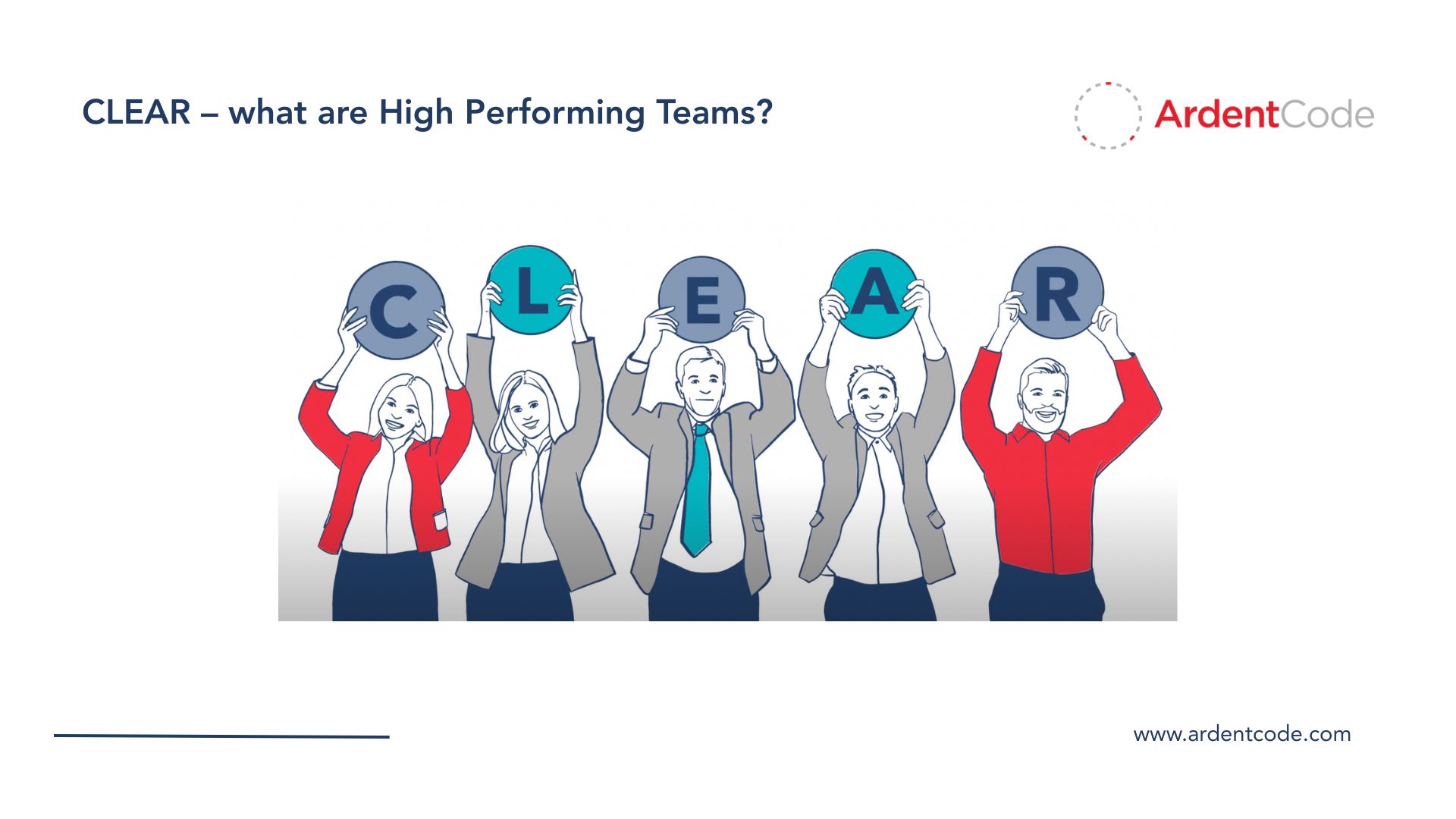
What are High Performing Teams?

Building teams is a demanding, long-term work. This is especially true when the teams join the structures of the clients and business partners to co-create new value with them. The motto of ArdentCode is building high performing teams. What does it mean? This is clear – the CLEAR model is what defines our DNA.

What is the CLEAR model?

It is a simple, logical, and exhaustive definition of a high performing team that we adopted in ArdentCode based on our long-term project experience. It is an acronym of the key terms that define the attributes of an organisation and a team. It was created as a result of our analysis of our long-term project experience.

C – Culture

Strong team culture that reflects the knowledge of each other’s preferences, strengths and limitations, and trust. Healthy organisational culture is also influenced by the ability to use conflicts and then to solve them in a constructive way.  A conflict may be understood as a factor that initiates change. The culture of the team may also be a catalyst of changes in the organisation. We understand it as the acceleration of changes in teams, also clients’ teams, fostered by constant sharing of knowledge and analysing actions.

L – Learning

The ability to learn new skills, but also to draw conclusions from the activities performed and to share knowledge within the team are the pillars that are necessary to build high performing teams. As a result of the fact that the company is developing constantly and creates conditions that foster learning, our clients receive added value: the guarantee that members of the teams that enter their structures will learn the necessary guidelines or information smoothly and quickly. This guarantees efficient cooperation.

E – Effectiveness

Speaking of efficiency, it is the fourth component of the CLEAR model. Effectiveness is understood as a guarantee of the quality of our work, but also the ability to adjust the work pace and organisation in a blended team. Thanks to that, the processes of creating solutions and applications for our client are more mature, and we are able to deliver on the arrangements and obligations towards our business partners.

A – Autonomy

Autonomy is one of the attributes that are the hardest to work out and, at the same time, indispensable in efficient companies. Still, it may be achieved by combining a proactive approach with the focus on solving problems, flexibility, and business awareness. Obviously, this is not easy, yet it is worth making the effort.Clients may assume that the team will be able to cope with the problems that may arise during cooperation and that it will not require micro-management. It also allows to clearly define the needs (that the team is aware of and able to communicate) and to reduce the participation of people from outside the blended team.

R – Reliable communication  

Reliable communication is the last, but very important pillar of the CLEAR model. It is defined as multi-level communication, both inside the company or the given team, and between the client’s team and ours. It is the communication that enables a clear definition of goals, roles, as well as the scopes of tasks and duties. This category also includes documenting and reporting, because informing about progress and recording the processes in the project are an important element of communication. As a result, our clients may be certain that the cooperation will be clear and transparent.

Conclusion

The attributes of high performing teams that have been described above allow us to better understand the values and competences that we wish to develop in high performing teams. Thanks to them, we know that we are able to offer our clients not only great developers, but also to have a real influence on the organisational culture in the structures of the companies with which we cooperate. Precisely this aspect has been appreciated by our business partners for years.

The CLEAR model is also presented in form of an animation. You may watch here, on our YouTube channel.

Solo or in a team? 

Surely, everyone knows when it’s better to work individually and when to be a part of a team. It’s so obvious! Or is it? We’ve prepared a summary outlining when it’s better to work alone and when it is more effective to engage a team. For those who prefer a quick glance, we’ve got a concise graphic. And for the others, we encourage you to read on. 

I’ll handle it myself

Tasks that require deep concentration, coherence, and quick decision-making are better done independently. This way, we can avoid the burden of having to discuss or wait for decisions. Acting solo also works well when there’s a high level of responsibility for results, independence, and control over processes. Tasks that require specialized skills form a separate category for solo work. 

Let’s do it together

Teamwork is more effective for projects or tasks that demand a variety of skills. This is often due to the complexity or scale of the project. Combining the knowledge of multiple experts helps find more comprehensive and innovative solutions. Similarly, tasks that require creativity and the exchange of ideas are better suited for a team. Complex, multidimensional issues are also better tackled in a group than alone, and tasks that require a high level of engagement—when there’s a lot to do in a limited time—benefit from building a team, which significantly increases the chances of success. 

When else should we build a team? 

In our organization, we place particular emphasis on learning competencies and sharing expert knowledge within the company. This is a natural and engaging way to develop skills and strengthen team bonds, leading to a high level of mutual trust among employees. Another important value at ArdentCode is effectiveness, which we understand as the combination of high quality, the right pace of action, and proper organization of work. 

Summary

Modern organizations face the challenge of balancing the choice between individual work and teamwork. The decision which path to choose depends on the problem at hand. Another challenge for companies is finding the golden mean between the need for independence and group work, especially when many team members are seasoned experts with high qualifications. However, those considerations will be left for another occasion.

5 proven ways to burn out the best ones

Let’s set some assumptions — ideally, articles about inappropriate management practices should not exist. But our daily reality is not a utopia, and burnout issues have been described from many perspectives and in many ways. However, to show how easy it is to lead the best people on the team to have a sense of futility, we present a ready-made recipe—applying these practices guarantees negative consequences, even in the short term.

1. Guess what I expect from you

Most misunderstandings and frustrations arise from gaps in communication. They may stem from managers’ failure to define the key areas for which team members are responsible. Another threat is the inconsistency in defining roles and responsibilities. Examples? One day, give an employee the feeling that they should take the initiative and that their suggestions are valuable. And shortly after, criticize them for their engagement and reduce them to a typical do-it role. However, when the project is delayed or problems arise, blame (and responsibility) should fall on the employee.

2. If I’m not criticizing it, It’s OK—don’t you know?

The highest form of praise is the absence of criticism? Great, if you want to smother any enthusiasm and engagement within your team. Some managers assume that the only form of feedback should be pointing out elements for correction or change, forgetting how important it is to appreciate positive aspects, progress, and development. Lack of appreciation is one of the most common problems in teams. An example from our backyard is a situation where an employee devoted all their energy and skills for weeks to meet expectations within the deadline. However, they received no feedback, so they took the initiative and proposed a one-on-one meeting. When they directly asked for feedback on their performance, they received a response that can be paraphrased as: “Don’t you know that if I don’t give feedback, it means that everything is OK?”

3. Don’t bother me, just get it done

Arrogant remarks directed at team members do not reflect one’s position or competencies but rather significant communication issues. It is worth noting that when involving an engineer with a specific specialisation in a project, it is necessary to trust their knowledge and skills. Pushing for an accelerated process or ignoring information about necessary solutions may result in the project’s failure. The consequence is burnout, manifested by indifference, a sense of powerlessness, and turning a dedicated specialist into someone who just blindly follows orders.

4. I say one thing but do another

There’s a known saying: “Paper will take anything.” But the moment of truth comes when it turns out actions don’t match words. Yet, consistency and responsibility are the key traits of leaders. Here, it’s worth citing an example we encountered in one of our collaborations. Specialists from ArdentCode faced a situation where the client’s representative often suggested ideas without specifying requirements. Changes in expectations, requirements, and vision were also frequent and unjustified for the project. Employees who were involved in this collaboration experienced a lack of stability in decisions. This created concerns since one of a leader’s roles is to provide a sense of stability and security, which are essential in effective and productive team work.

5. What are you saying? You’d better look at yourself

Gaslighting[1] may occur not only in romantic relationships but unfortunately also in professional situations. It’s enough to conduct conversations in a way that instills doubt in the recipient about their maturity, experience, skills, and knowledge. A representation of this status may be a situation where a specialist (yet again) takes the initiative to talk about the team’s situation, project, and the communication style of the project manager. To quickly and efficiently destroy their commitment, just do not accept the criticism backed by specific arguments (constructive criticism). To defend yourself, throw in something about a personal attack and lack of professionalism.  In this way, you will stir up guilt in the employee attempting to change the situation and admit that the problem indeed lies with them.

Summary:

Each of these attitudes will negatively affect the team. Combining them practically guarantees quickly burning out even the resilient and ambitious employees. The ironic tone of this article should not overshadow its real message — that the behaviour described above indicates a lack of leadership skills and improper selection of management methods. At ArdentCode, we place a strong emphasis on effectively preventing burnout among team members, even if they are affected by a negative style of collaboration with clients. We will write about these methods in our future materials.


[1]https://www.newportinstitute.com/resources/mental-health/what_is_gaslighting_abuse/

Case Study

Improvement of Legal Research: 

ArdentCode’s DevOps Transformation for Wolters Kluwer’s VitalLaw

Introduction:   

ArdentCode partnered with Wolters Kluwer to upgrade their flagship legal research platform – VitalLaw (former Cheetah™). It was a challenge to introduce DevOps practices to a large-scale, multi-year project. ArdentCode aimed to increase frequency of production deployments and lower the time needed for change implementation. 

Focus: 

Objective:  

Enhance the development process for VitalLaw, while maintaining the highest standards of security. 

Needs: 

  1. Increase frequency of production deployments and lower the time needed for changes implementation 
  2. Introduce DevOps practices to VitalLaw – large scale, multi-year project 

Approach: 

  1. Continuous Integration: Through DevOps practices, ArdentCode team was able to change production deployment from two months to bi-weekly production releases. This change also gave a possibility for daily deployments. 
  2. International blended team creation: ArdentCode used DevOps tooling and practices across teams in the USA, Europe, and India, facilitating collaboration and efficiency. 
  3. Process improvement: The adoption of the Scaled Agile Framework (SAFe) enabled smoother development processes and enhanced agility. It was conducted in accordance with the client’s internal processes. Needed improvements were also enhanced.
  4. Testing and verification: There was a need to test the application in a different way – it was a basic need of the project.  The goal was to reduce testing time. We changed the scope of testing to automatically test only the areas touched in the code.  As a result, instead of testing in a few working days, we were able to deliver some changes in a few hours, with testing taking much less time once the changes were made. The number of e2e tests was reduced to each release, integrating with external applications to support testing.  

Key changes

Results: 

  1. Accelerated deployment: Deployment frequency increased from 2 months to 2 weeks, with the ability to deploy changes on a daily basis. 
  2. Changes in shortened time: Teams were able to deliver required changes more quickly. 
  3. Agility: Every code change (Pull Request, Merge Request) is a potential release candidate. 
  4. Rollback on demand: Rollback to previous version on demand  
  5. Improved stability: Less number of regression bugs. Higher confidence in the release quality. 
  6. Comprehensive tooling: DevOps tooling and practices were successfully integrated across all collaborating teams, enhancing collaboration and efficiency. 
  7. Security and elevated performance: ArdentCode ensured rigorous security and performance verification, maintaining the highest standards for VitalLaw. 

Conclusion: The adoption of comprehensive DevOps practices by ArdentCode resulted in a significant change, thanks to the reduction of deployment timelines from months to weeks, and the introduction of daily deployment capabilities. The operational shift not only accelerated change delivery but also fostered a culture of agility, where every code change became a potential release candidate, enhancing adaptability and responsiveness within the organization. Moreover, the emphasis on rollback capabilities and the observed decrease in regression bugs underscored a commitment to stability and quality assurance, reflecting a pragmatic approach to software development that prioritizes efficiency and reliability.  

Pro-activity, why is it a value? 

There are dozens of values which companies could present as the most important. But in ArdentCode we truly believe that pro-activity is our own key to build long-term and meaningful cooperation with business partners.  

At the beginning of business cooperation, both sides agree on the terms regarding the conditions and scope of work. At this stage it is difficult to decide what else should be taken into account. When developers and experts from ArdentCode connect with internal client’s team to build a blended team, they find areas which could be re-defined or developed. Based on mutual trust and respect, we can discuss additional projects or project areas to make an application or solution more effective and user-friendly.  

How do we understand pro-activity? 

In our structures we are familiar with providing all the results and effects which were referred to in the contract. This is the priority. What is also important is that we are open-minded, and therefore we look carefully at other areas, not only based on development. For example, in the course of fostering Project One, for Wolters Kluwer, we also took care of task management in JIRA. Another example is our work with Spotler, when we configured and maintained CI/CD infrastructure to automate application builds. In the last few months, for one of our clients we applied our knowledge and experience to check the architecture and software development process from a performance point of view.  

Why is pro-activity a game-changer?  

We know that details make huge difference for quality. For instance, turning on cameras during meetings, sharing live examples at the demo instead of presenting slides or, finally, contributing our technical and process-related observations on how to improve the development of the project. These and many other “tiny” changes create a connection based on professionalism, trust and intuitive willingness to improve.  

In ArdentCode pro-activity and client-oriented attitude is natural, embedded in the work culture and work ethic. Meeting the needs of customers, which becomes part of daily operations, is one of the foundations of work at the company. Already at the recruitment stage, we verify that candidates will adjust themselves to the structures of a team whose pro-activity is part of the primary offer to customers. 

Empowering High-Performance Teams: Seamless Remote Cooperation

Remote work and the flow of competencies between teams have allowed international collaborations to develop between corporations and smaller organizations. Since 2020, many companies have retained the freedom to choose their work locations. Experiencing the efficiencies of remote work has greatly influenced the willingness to collaborate with IT service providers from different countries. 

Creating new communication structures, mastering remote project management, and building high-performance teams consistently contribute to maintaining satisfactory results. This applies both to the company’s own internal departments and to mixed teams, i.e., those formed jointly by the company and specialists employed by external contractors. 

From a business perspective, building and developing remote teams positively affects, for example, the process of knowledge flow. The selection of top specialists is based on their experience and skills, irrespective of their location.  

An important aspect of building high-performance teams involves the ability to enter project preparation or implementation phases seamlessly. This eliminates the need for lengthy and costly recruitment, training, and orientation processes for both in-house and external employees. 

Embracing blended teams has a key advantage: the ability to kickstart projects right after signing agreements. This ensures swift task distribution and knowledge sharing from the get-go. Unlike expanding internal departments, there’s no need for complicated and expensive recruitment. Collaboration can be planned on a project or periodic basis. As a result, the costs of initiating changes in the team are significantly lower, and existing employees do not have to spend hours onboarding new team members. In addition, by focusing on partnerships and co-creating customer success, know-how stays within the organization and is supported by experts hired for projects from outside.    

How to take care of high performance in blended teams?  

Communication of needs, definition of areas of responsibility, and mutual respect and trust in the process of building technology solutions lie at the heart of any collaboration. Opening to each other’s needs and defining the terms of cooperation with an indication of milestones in projects make it easier to keep morale high. Jointly seeking solutions and making improvements also fosters a sense of caring to deliver the best results.  

Over the course of more than 20 years in business, ArdentCode has developed its mechanisms for nurturing high-performance teams, emphasizing precise issues right from the recruitment stage and selecting team members in line with company values. This helps strengthen the structure of teams, whose members naturally bring them to clients’ teams.