What are High Performing Teams?
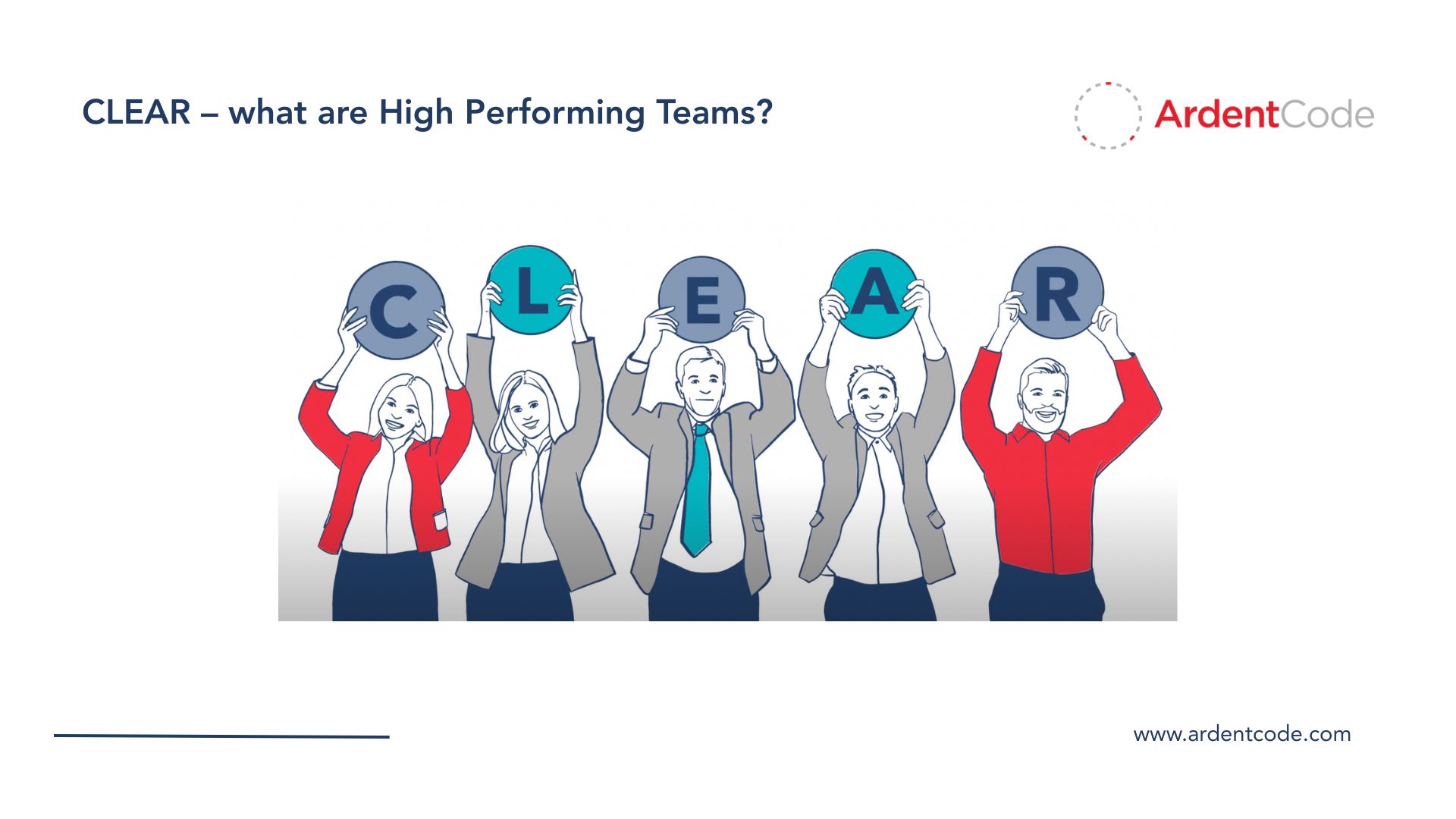
Building teams is a demanding, long-term work. This is especially true when the teams join the structures of the clients and business partners to co-create new value with them. The motto of ArdentCode is building high performing teams. What does it mean? This is clear – the CLEAR model is what defines our DNA.

What is the CLEAR model?
It is a simple, logical, and exhaustive definition of a high performing team that we adopted in ArdentCode based on our long-term project experience. It is an acronym of the key terms that define the attributes of an organisation and a team. It was created as a result of our analysis of our long-term project experience.
C – Culture
Strong team culture that reflects the knowledge of each other’s preferences, strengths and limitations, and trust. Healthy organisational culture is also influenced by the ability to use conflicts and then to solve them in a constructive way. A conflict may be understood as a factor that initiates change. The culture of the team may also be a catalyst of changes in the organisation. We understand it as the acceleration of changes in teams, also clients’ teams, fostered by constant sharing of knowledge and analysing actions.
L – Learning
The ability to learn new skills, but also to draw conclusions from the activities performed and to share knowledge within the team are the pillars that are necessary to build high performing teams. As a result of the fact that the company is developing constantly and creates conditions that foster learning, our clients receive added value: the guarantee that members of the teams that enter their structures will learn the necessary guidelines or information smoothly and quickly. This guarantees efficient cooperation.
E – Effectiveness
Speaking of efficiency, it is the fourth component of the CLEAR model. Effectiveness is understood as a guarantee of the quality of our work, but also the ability to adjust the work pace and organisation in a blended team. Thanks to that, the processes of creating solutions and applications for our client are more mature, and we are able to deliver on the arrangements and obligations towards our business partners.
A – Autonomy
Autonomy is one of the attributes that are the hardest to work out and, at the same time, indispensable in efficient companies. Still, it may be achieved by combining a proactive approach with the focus on solving problems, flexibility, and business awareness. Obviously, this is not easy, yet it is worth making the effort.Clients may assume that the team will be able to cope with the problems that may arise during cooperation and that it will not require micro-management. It also allows to clearly define the needs (that the team is aware of and able to communicate) and to reduce the participation of people from outside the blended team.
R – Reliable communication
Reliable communication is the last, but very important pillar of the CLEAR model. It is defined as multi-level communication, both inside the company or the given team, and between the client’s team and ours. It is the communication that enables a clear definition of goals, roles, as well as the scopes of tasks and duties. This category also includes documenting and reporting, because informing about progress and recording the processes in the project are an important element of communication. As a result, our clients may be certain that the cooperation will be clear and transparent.
Conclusion
The attributes of high performing teams that have been described above allow us to better understand the values and competences that we wish to develop in high performing teams. Thanks to them, we know that we are able to offer our clients not only great developers, but also to have a real influence on the organisational culture in the structures of the companies with which we cooperate. Precisely this aspect has been appreciated by our business partners for years.
The CLEAR model is also presented in form of an animation. You may watch here, on our YouTube channel.
Sustainable team growth

Concluding our series, this article is the final installment of a three-part series on building high-performance software development teams.
Achieving success is one thing; sustaining it is another. In this final installment, we’ll explore strategies for sustaining success and fostering growth within software development teams for a long-term success and continued innovation.
Nurturing talent
To achieve the growth and development of team members, companies need to invest in them. How? By providing opportunities for learning and advancement, mentorship programs and access to resources that foster professional growth. By nurturing talent from within, organizations cultivate a culture of continuous improvement and innovation. To prove the foregoing, at ArdentCode we have experts who have worked in the IT industry for over 15 years, which is meaningful, indeed.

Staying agile and adaptive
Today, agility is key. It is important to encourage a team to embrace change, adapt quickly to new technologies and market trends, as well as continuously iterate and improve their processes. By staying agile and adaptive, teams can respond swiftly to challenges and capitalize on emerging opportunities.
Leading by example
Being a leader forces us to lead by example. What is also important is to present the values and principles not only on paper, but also in daily working with a team, fostering a culture of transparency, communication and collaboration, providing a role model to employees. At ArdentCode annual feedback and review is created not only for the team, but for the board members and leaders, too, because there is always an opportunity to make changes.
In summary, sustaining success and fostering growth within software development teams requires a multifaceted approach that encompasses talent development, diversity and inclusion, agility, leadership and resilience. By implementing these strategies, organizations can build teams that do not only achieve success in the short term, but also thrive and innovate in the long run, ensuring continued growth and success in an ever-changing digital environment.
Our series on building high-performance software development teams has emphasized the essential components of strategic recruitment, continuous growth, shared vision and collaborative culture. These elements are the key to empowering teams to navigate challenges, foster innovation and attain remarkable outcomes. By prioritizing creativity, sustainability and long-term success, organizations can cultivate thriving software development teams ready to flourish in today’s ever-evolving digital realm.